Books about Bethlehem

There’s no one I’d rather be next to on a bookshelf

The writer and social observer Joan Didion claimed to be bad at interviewing people and did not like to make telephone calls. She said her only advantage as a reporter was being “so physically small, so temperamentally unobtrusive, and so neurotically inarticulate that people tend to forget that my presence runs counter to their best interests.” But she could turn a phrase! Incisive, she would get right to the heart and look every which way at her subject. “Slouching Towards Bethlehem” is from a line in a W. B. Yeats poem and the title of the first Didion book I ever read. In it, her topics ranged nominally from famous Californians to her private life but she really wrote about humanity. I hope someday someone will make that claim about me, too.

My next step on that journey is “Belonging to Bethlehem: Stories from the Christmas City’s Jewish Community.” The book explores the lived experiences of nearly 100 people in the course of a century of this one Jewish community named for the birthplace of another religion. Many voices are woven together and tell stories to which just about anyone will relate.

“Belonging to Bethlehem is available now at Barnes & Noble, Amazon, and Bookshop.org (whose virtual book shelf is the subject of this little musing).

Belonging is a journey

Belonging is a Journey

Stars, much has been made of them in Bethlehem, Pennsylvania, where I live. There’s the Star of Bethlehem shining from South Mountain every night, visible across the city. There are the Moravian stars, with their 26 points, gracing many front porches, shops, and more. People can be stars also. Maybe they stand out in their community as leaders. Or maybe they’re so-called ordinary people who just really make a difference to those around them. Many times that difference has to do with welcoming a stranger, helping someone through a hard time, or just showing up for others, offering them a sense of belonging and being cared about.

Belonging is multifaceted

As I researched “Belonging to Bethlehem: Stories from the Christmas City’s Jewish community” I realized that belonging is a little bit like those stars, meaning multifaceted. I used to think that belonging was an either/or situation, binary. But it’s not. Belonging is much more nuanced than that. It may involve longing, joy, disappointment. Getting to belonging is a journey and often a process of fits and starts. Interviewing nearly 100 people for this project, I noticed that nearly everyone struggles with belonging; some more than others. I wonder if it ever really goes smoothly for anyone.

We do have some control

The other thing about belonging is that it is sometimes possible to influence our own or another’s sense of belonging. Our own: this may be by taking the first step, going to an event, a festival, a class, saying hello to someone at school or where you get coffee. Others: It may mean welcoming someone who has shown up in your life, motioning for someone to sit next to you, asking an acquaintance to tell you a little more about themself. These are all positive steps we can do today to increase that feeling of belonging. More negative would be the comment without thinking, the procrastinating about or avoidance of getting involved. In any case, it doesn’t take much to move ourselves or others forward or backwards along that path of belonging.

Stepping out of the comfort zone

In a world where loneliness is called an epidemic, there are simple, easy steps that we can all take. But the very first step is to free ourselves of the idea that “well, they belong and I don’t.” “Belonging to Bethlehem” is about a group of people living in a city named for the origin story of another religion! Yet most people grew into a sense of belonging. One person featured in the book, sharing about his Jewish schoolmates, was the Italian-American son of a Bethlehem steelworker. Who could better belong to Bethlehem? But no, he too experienced extraordinary isolation and had to find his way just like everyone else. “Belonging to Bethlehem” is filled with the personal stories of people who have experienced that journey, sharing reflections that light the way.

what goes around comes around

A merry-go-round of our own

Just saw Jeremy Allen White as Bruce Springsteen in “Deliver Me From Nowhere.” In the movie, Bruce’s songs are a mash up of past and present. It’s all relevant when it comes to creativity. That’s sort of how life is at times, too. At least, that’s what I noticed in researching my forthcoming book: “Belonging to Bethlehem: Stories from the Christmas City’s Jewish Community,” spanning 100 years.

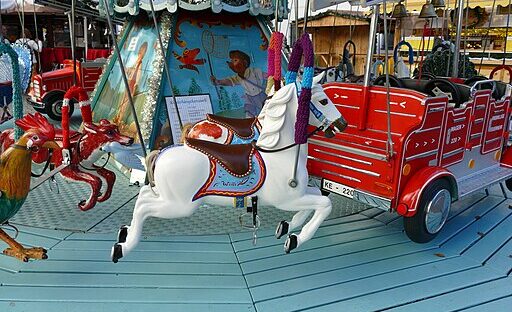
The backdrop events of those years show that what goes around comes around, like the merry-go-round in one scene of the movie.

It’s easy to get a little too caught up in the carnival — whether our own personal daily dramas, national politics, or anything in between. So many incidentals in the book seemed, when I began my research in 2010, mere trivia. Back then, it felt like things were on the upswing after the market instability of ’06-’08. 

A pandemic, immigration controversy, childhood disease outbreaks, civil unrest … Ancient history, right? Then we descended into 2020 and beyond.

Yet like Bruce’s river in “Hungry Heart,” the one that “don’t know where it’s flowing,” things just kept going. 

Crises don’t last.

We could take comfort in the cyclical nature of events, which offers the pendulum’s swing of escape from hard times and controversy. Things get bad, like when they “blew up the chicken man” in another of Bruce’s songs. And then they get better. Or as Bruce would say, “Maybe everything that dies, someday comes back …”

If we’re lucky, that upswing will lead to something really beautiful, as heard in the refrain and ending of that chicken man song; as seen in the creative outpouring of swirled memories, a book, an album, a win, a work project or initiative; … or a feeling, of sheer joy, when Bruce once again sings, “Meet me tonight in Atlantic City!”

Photo attribution: Kritzolina, CC BY-SA 4.0 <https://creativecommons.org/licenses/by-sa/4.0>, via Wikimedia Commons; page link.