The writer and social observer Joan Didion claimed to be bad at interviewing people and did not like to make telephone calls. She said her only advantage as a reporter was being “so physically small, so temperamentally unobtrusive, and so neurotically inarticulate that people tend to forget that my presence runs counter to their best interests.” But she could turn a phrase! Incisive, she would get right to the heart and look every which way at her subject. “Slouching Towards Bethlehem” is from a line in a W. B. Yeats poem and the title of the first Didion book I ever read. In it, her topics ranged nominally from famous Californians to her private life but she really wrote about humanity. I hope someday someone will make that claim about me, too.
My next step on that journey is “Belonging to Bethlehem: Stories from the Christmas City’s Jewish Community.” The book explores the lived experiences of nearly 100 people in the course of a century of this one Jewish community named for the birthplace of another religion. Many voices are woven together and tell stories to which just about anyone will relate.
“Belonging to Bethlehem is available now at Barnes & Noble, Amazon, and Bookshop.org (whose virtual book shelf is the subject of this little musing).
Stars, much has been made of them in Bethlehem, Pennsylvania, where I live. There’s the Star of Bethlehem shining from South Mountain every night, visible across the city. There are the Moravian stars, with their 26 points, gracing many front porches, shops, and more. People can be stars also. Maybe they stand out in their community as leaders. Or maybe they’re so-called ordinary people who just really make a difference to those around them. Many times that difference has to do with welcoming a stranger, helping someone through a hard time, or just showing up for others, offering them a sense of belonging and being cared about.
Belonging is multifaceted
As I researched “Belonging to Bethlehem: Stories from the Christmas City’s Jewish community” I realized that belonging is a little bit like those stars, meaning multifaceted. I used to think that belonging was an either/or situation, binary. But it’s not. Belonging is much more nuanced than that. It may involve longing, joy, disappointment. Getting to belonging is a journey and often a process of fits and starts. Interviewing nearly 100 people for this project, I noticed that nearly everyone struggles with belonging; some more than others. I wonder if it ever really goes smoothly for anyone.
We do have some control
The other thing about belonging is that it is sometimes possible to influence our own or another’s sense of belonging. Our own: this may be by taking the first step, going to an event, a festival, a class, saying hello to someone at school or where you get coffee. Others: It may mean welcoming someone who has shown up in your life, motioning for someone to sit next to you, asking an acquaintance to tell you a little more about themself. These are all positive steps we can do today to increase that feeling of belonging. More negative would be the comment without thinking, the procrastinating about or avoidance of getting involved. In any case, it doesn’t take much to move ourselves or others forward or backwards along that path of belonging.
Stepping out of the comfort zone
In a world where loneliness is called an epidemic, there are simple, easy steps that we can all take. But the very first step is to free ourselves of the idea that “well, they belong and I don’t.” “Belonging to Bethlehem” is about a group of people living in a city named for the origin story of another religion! Yet most people grew into a sense of belonging. One person featured in the book, sharing about his Jewish schoolmates, was the Italian-American son of a Bethlehem steelworker. Who could better belong to Bethlehem? But no, he too experienced extraordinary isolation and had to find his way just like everyone else. “Belonging to Bethlehem” is filled with the personal stories of people who have experienced that journey, sharing reflections that light the way.
Just saw Jeremy Allen White as Bruce Springsteen in “Deliver Me From Nowhere.” In the movie, Bruce’s songs are a mash up of past and present. It’s all relevant when it comes to creativity. That’s sort of how life is at times, too. At least, that’s what I noticed in researching my forthcoming book: “Belonging to Bethlehem: Stories from the Christmas City’s Jewish Community,” spanning 100 years.
The backdrop events of those years show that what goes around comes around, like the merry-go-round in one scene of the movie.
It’s easy to get a little too caught up in the carnival — whether our own personal daily dramas, national politics, or anything in between. So many incidentals in the book seemed, when I began my research in 2010, mere trivia. Back then, it felt like things were on the upswing after the market instability of ’06-’08.
A pandemic, immigration controversy, childhood disease outbreaks, civil unrest … Ancient history, right? Then we descended into 2020 and beyond.
Yet like Bruce’s river in “Hungry Heart,” the one that “don’t know where it’s flowing,” things just kept going.
Crises don’t last.
We could take comfort in the cyclical nature of events, which offers the pendulum’s swing of escape from hard times and controversy. Things get bad, like when they “blew up the chicken man” in another of Bruce’s songs. And then they get better. Or as Bruce would say, “Maybe everything that dies, someday comes back …”
If we’re lucky, that upswing will lead to something really beautiful, as heard in the refrain and ending of that chicken man song; as seen in the creative outpouring of swirled memories, a book, an album, a win, a work project or initiative; … or a feeling, of sheer joy, when Bruce once again sings, “Meet me tonight in Atlantic City!”
Photo attribution: Kritzolina, CC BY-SA 4.0 <https://creativecommons.org/licenses/by-sa/4.0>, via Wikimedia Commons; page link.
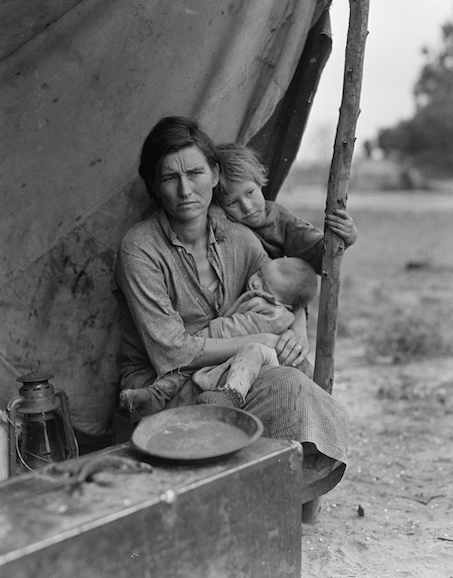
Dorothea Lange snapped her iconic “Migrant Mother” photo in 1936, the height of the Great Depression. In that photo, the mother, her face furrowed with worry, holds her infant; she supports two other young children leaning on her shoulders. Their faces are turned away from the camera. But here in this photo, we see another view, one that far fewer people have seen. The child at her mother’s shoulder now is more relaxed, more connected.
This woman in the photo was Florence Owens Thompson, 32-year-old mother of seven and of Cherokee descent. She became the face of an incredibly challenging era in American history. Her family was resting temporarily at a pea-pickers camp in California. You can see in this photo the makeshift tent they have assembled. It was here that Lange, employed by the Farm Security Administration, found Florence Owens Thompson and her children. The resulting series of photographs telegraphs hardship and endurance to the viewer.
Words, too, can go a long way toward connecting us with one another. Just as familiar as the subject of this photo are the many names from the Federal Writers’ Project (1936-40). Names like John Steinbeck, Zora Neale Hurston, and Eudora Welty. FWP was part of President Franklin D. Roosevelt’s the Works Project Administration. The writers and photograpers were dispersed to document. This task was on par with other objectives of the program, like the building of national parks, bridges, and highways. Then there was the education of young men via the Civilian Conservation Corps (CCC), many of whom mailed their earnings back home to families otherwise destitute due to drought and famine.
For the FWP, people in cities and in the most remote corners of the country told these writers the stories of their everyday lives during the 1930s. They shared where they had come from. They described what kind of work they did. Some recounted the famous and not so famous people they had met. But why would this be such a crucial part of the WPA’s mission?
These life histories became a record of American life. That matters. FWP writers documented just what they heard and witnessed. Through their work, they preserved the stories of so-called every day people who, as the Migrant Mother photos illustrate, just may be extraordinary, too.
The Library of Congress’s page on the program offers a fascinating insight as to why the New Deal very intentionally included documenting these stories. “Most life histories were gathered under the direction of Benjamin A. Botkin, the folklore editor of the Writers’ Project. Like many intellectuals of his generation, Botkin was horrified at the rise of fascism in Europe and worried about possible consequences of that trend at home. By assembling occupationally and ethnically diverse life histories, he hoped to foster the tolerance necessary for a democratic, pluralistic community.”
There’s a reason that goes beyond even that one. It’s relevant to every decade, every generation. Most of life happens in our everyday moments, rather than the big events or even the selfie photos. That’s where we can find out what is most elemental in our lives. What we care about, how we live our lives, and what we remember can all be seen in the candid moments that too often go unnoticed. They can be found in the life histories — the stories — we perhaps too infrequently tell. But these stories can make a difference to the people who hear them, witness the unposed moment, or listen to the story or thought that only you can share. In Lange’s photo, the mother is taking what is probably a rare moment for repose and reflection, as we all need to do. What’s on your mind today? Who might you reach out to and share that story?
Photo source: Library of Congress, Prints & Photographs Division, Farm Security Administration.
We all have the same purpose, I was surprised to read in Doctor-writer-life scientist Deepak Chopra’s “The Book of Secrets.” Chopra writes that our shared purpose is to help the world “expand and grow.” He suggests it may be counterproductive to have rigid goals and to struggle too hard to meet well-defined timelines, because of what we might miss. All you need to do, he writes, is commit to fully explore your own life. In this way will you find your part in the big picture — the ways in which you can help the world. These daffodils have got it without even trying. Why shouldn’t we?
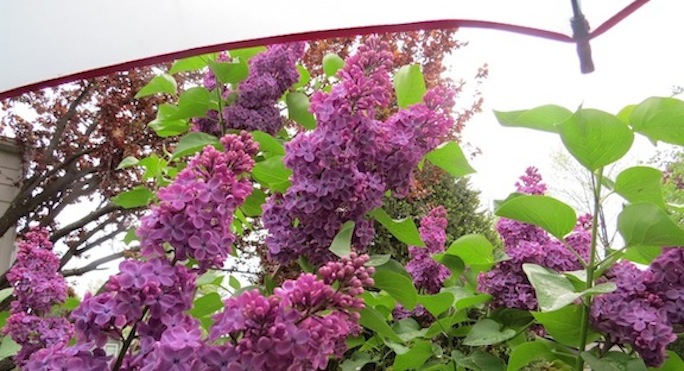
When the interviewer asked if I’d ever dealt with union officials, it seemed best to admit: “That will be a learning area for me.” Was it ever! I privately thought of one key person as a well-known figure in the French revolution and dreaded antagonizing him; yet interacting with him helped me learn when to stand my ground and how to facilitate discussions. We all have the people with whom we’d prefer to have lunch, the recreation at which we excel, the place — be it mountaintop or sailboat — where we feel most alive or most comfortable. Let’s call that the “umbrella.” The problem is, umbrellas block the view. Outside of your umbrella are, yes, more risks, but also opportunities, whether to enjoy beauty — as I did on a recent rainy morning — reach an unforeseen audience, or grow into the people we can become. Don’t believe me? Go ahead, take a peek.
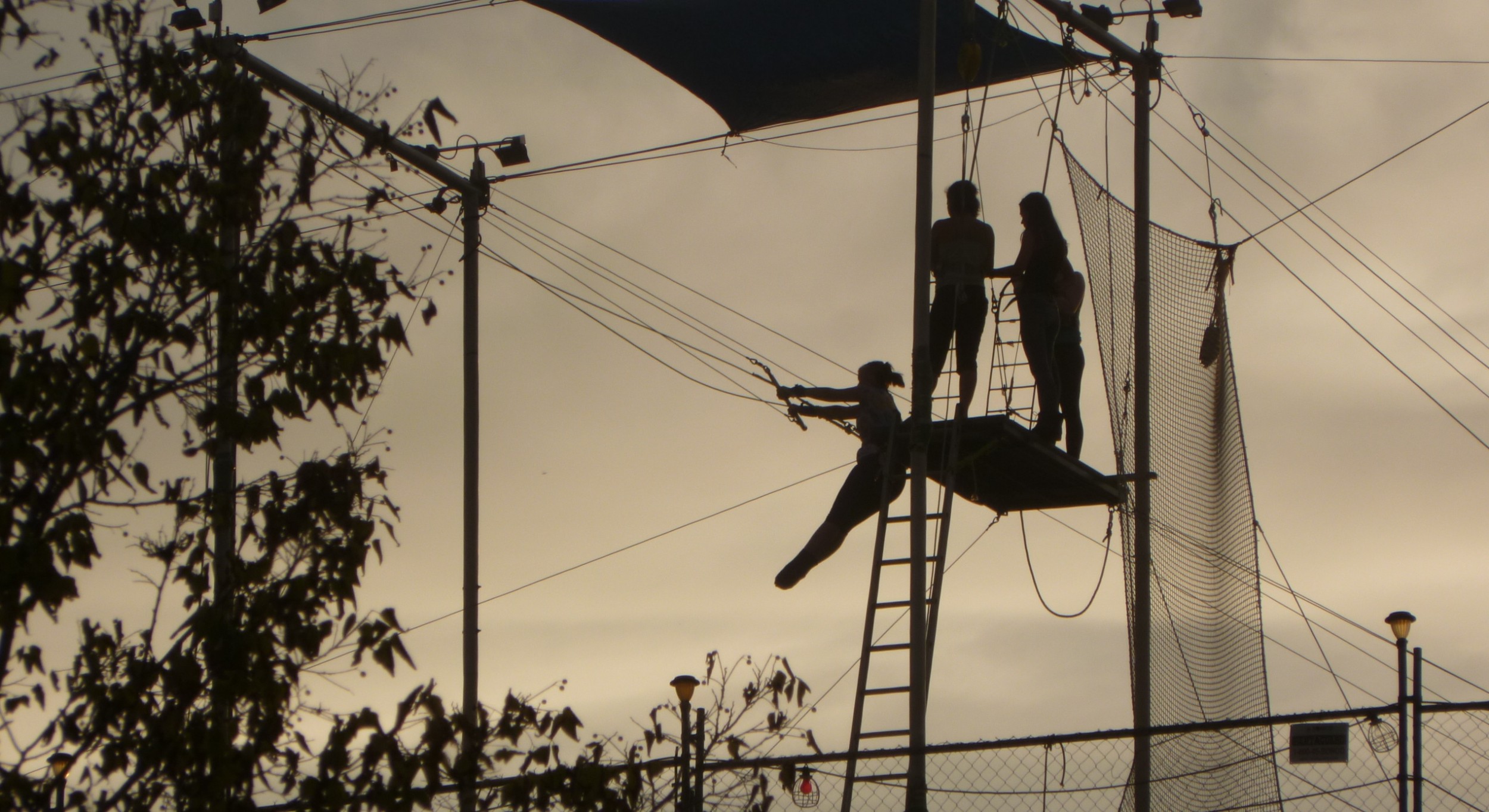
As our car inched along by the Hudson River on Manhattan’s far western edge, a trapeze school came into view, way up high, silhouetted against the sunset. Gridlocked, we watched student after student climb the ladder, grab the swing and … go! Every student took flight, guaranteed. With this kind of exposure, above their gigantic sign, it wasn’t know-how the school was selling. They were selling a feeling, one that all of us with our bumpers up against each other wanted. Some might call it freedom; others happiness or courage. People buy based on feelings. What feeling does the best use of your abilities offer your employer, client, or community? That feeling is the particular value you bring. If you imagine it’s your swing and grab on, there’s no telling where it will take you.
An acquaintance recently described to me his method of looking for a new job; he had a system, he said, but no job yet. Then he described a major fundraiser, a medical situation, and an entrepreneurial project; he revealed his frustration that his income does not match his energy output. Do you see the problem? Meanwhile, a client who works with college students talks about their “information overwhelm.” A brilliant organizational theorist describes rapid technological change with which it is nearly impossible for CEOs to keep pace, no matter how hard they try. We are all aware of a cacophony of demands, channeled to us 24/7 through electronic devices, “to-do lists,” and the people in our lives. What’s scarce and needed is attention. For multi-talented businesspeople tired of trying hard and not gaining the hoped-for ground, this means choosing a specialization and clearly stating the mission, then finding helpers to handle the rest. Not only does this enable others to understand what you are about and how you can help, but the clarity is a relief to everyone, eliminating the “static” and all that would get in the way of your call to action. When you concisely describe what you do, who you help and how, you convey a message of capability and competence, something on which to focus amidst the encroaching jungle of demands.
Headlines help the reader decide whether to read or move on. You have a headline all your own if you are on LinkedIn. It’s just below your name, and may appear to be your current or former job title. That’s because the site populates your headline from your job experience section. You can make the most of this prime space and here’s how.
Didn’t know your headline could be edited? On your home page, choose “profile” and “edit profile.” Put the cursor on the words just below your name and single-click. The space turning blue is your cue to type your very own advertisement in the text box that appears to the right. If you edit your headline, the job title that was formerly your headline will appear in smaller letters below it.
Some headlines give a one-word profession: architect, attorney, Batman (just checking!). Assuming you aren’t the only one (like Batman is), try stating what you do and what’s unique about how you work: “Lamp repair and you pay nothing until it shines!”
Other headlines have it all: “applications programmer/senior analyst, radiology department, University of …” Stopped reading yet? I did.
My headline comes in at just under LinkedIn’s limit of 120 characters — check it out and browse your connections to find headlines that you like. LinkedIn will show you some as well if you click on “Show examples” below the text box where you edit your headline.
So how about taking two minutes to do this for yourself, not just the two seconds you usually allot to you and — supposedly — to every stop sign you meet!
If you’d like some free and confidential feedback on your new or prospective headline, send it to me in the comment section below or via LinkedIn’s inmail and I’ll respond. Consider it my Valentine’s Day gift to you.
Do you ever long for a change? Wish to be your own boss or, if you already are, to instead take a job with a regular paycheck? Do “snow days” for you mean frenetically working from home while several children climb over your head? Just last week while sitting in my kitchen on such a day, in anguish I exclaimed to my 12-year-old, “I’m trying to think of a headline!” Well, the newspaper went to press right on schedule and then I went home last Friday for good.
Three weeks ago, I resigned from that much-loved job of three years. Anxiety? Yes, but conditions seemed right — almost like the perfect storm, which actually held off until the following Monday (today). This was the day I’d planned to take steps toward launching my writing and editing enterprise. However, a nor’easter blew in and plastered the streets with snow; oh no, this isn’t an allegory! Yet the website was already set up (feel free to browse), my calendar clear, and a rate sheet in the offing. With school cancelled and rowdies in the house (well, out sledding at the moment), it was time to scale back plans and enjoy a day off for a wonderful change!